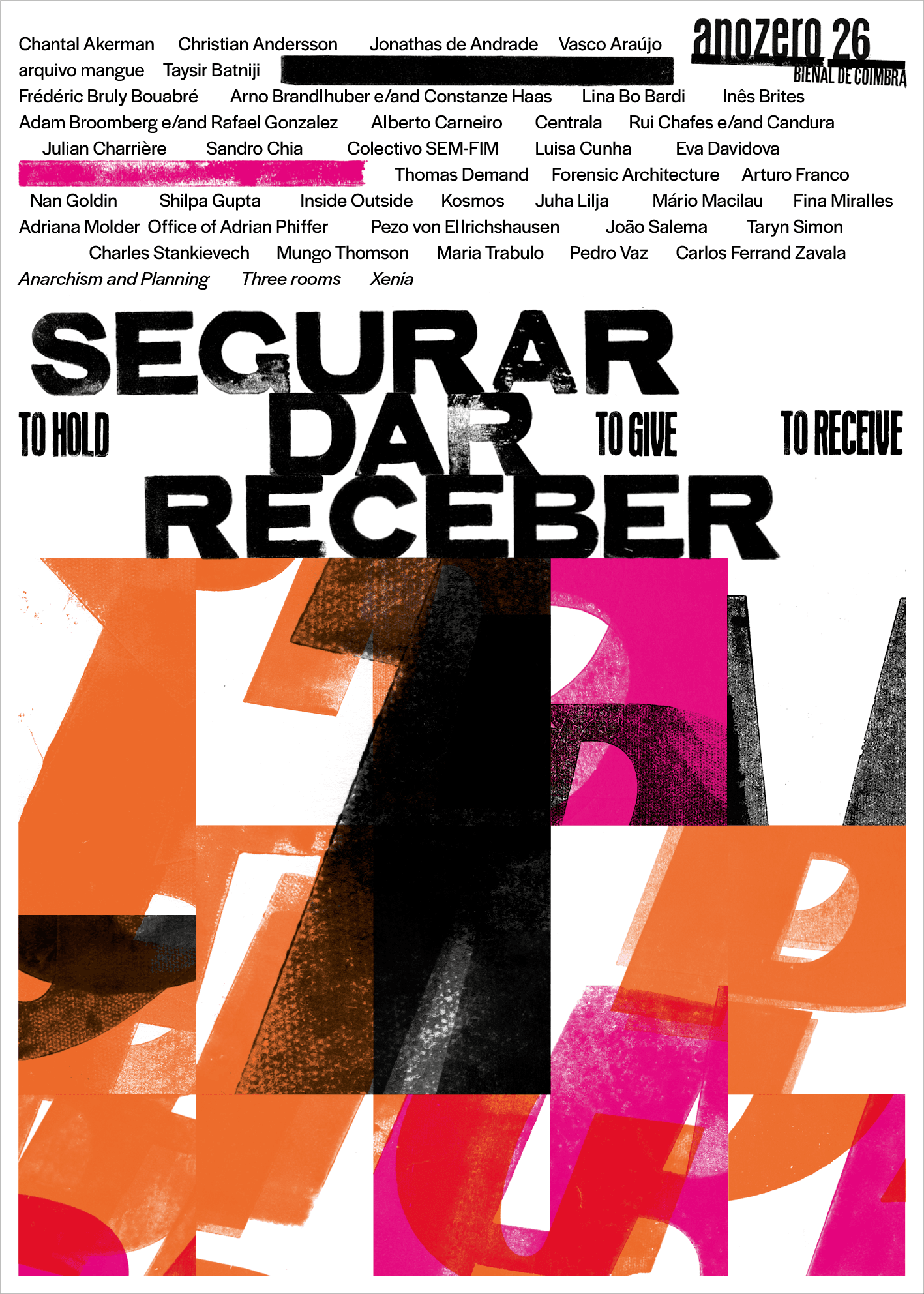
To Hold, To Give, To Receive
Language lays bare how we understand the world. Words not only reflect the world we inhabit but also how we inhabit it. Just like ‘to exhibit, the verb ‘to inhabit’ has a proto-Indo-European root: *ghabh.
There is no complete consensus, but the prevailing hypothesis is that all Indo-European languages originated from the eastern part of Ukraine. This is where about seven thousand years ago people may have uttered the word ‘*ghabh’ or something to that effect, whose triple meaning may seem paradoxical at first glance, ’to hold, to give, to receive’. But any contradiction evaporates when giving and receiving are not seen as one-directional, zero-sum exchanges but as reciprocal acts that can assume many forms.
The idea behind Anozero’26 was not to look for an external theme, but to let the theme emerge out of the exhibition itself, and, given the important architectural component of this edition, to dwell upon the essence of being in the world, as inhabiting it. It approaches the exhibition as a place that holds, gives, and receives; the artist as someone gifted with a talent that leads to art that is shared with a viewer; the habitat as a place that receives people and gives shelter.
To hold, to give, to receive reveals a reciprocity, which is aligned with Peter Kropotkin’s concept of mutual aid, and also with microbiologist Lynn Margulis’s understanding of symbiosis as the driving force of evolution and creativity.
We are living in a world in which economic disruptions are lauded as creative destruction; in which the word ‘mutual’ is less associated with mutual aid than with the spectre of mutual destruction. It is a world of gross inequalities and a concerning turn to right-wing authoritarianism. In this sense, To hold, to give, to receive is meant as a mild yet firm event of resistance, a manifesto for horizontality, mutual aid, symbiosis, and reciprocity.
Art and architecture are rarely changing the world directly, but they do so indirectly, by changing how we can see them, and how we live them, and live in them.
Anozero’26 highlights art and architecture that blur the line between disciplines, and presents projects that – implicitly or explicitly – give, give back, give forward, and are receptive, to people, to interpretations. Art that is hospitable, architecture that is generous.
If art, architecture, artists and architects cannot change the world, only how we experience it, then our role as curators is to frame their views, to make visible what the art and architecture brought together for this event entail, hold in store and have to offer to visitors, and perhaps, eventually, influence their understanding of the world.
Curators
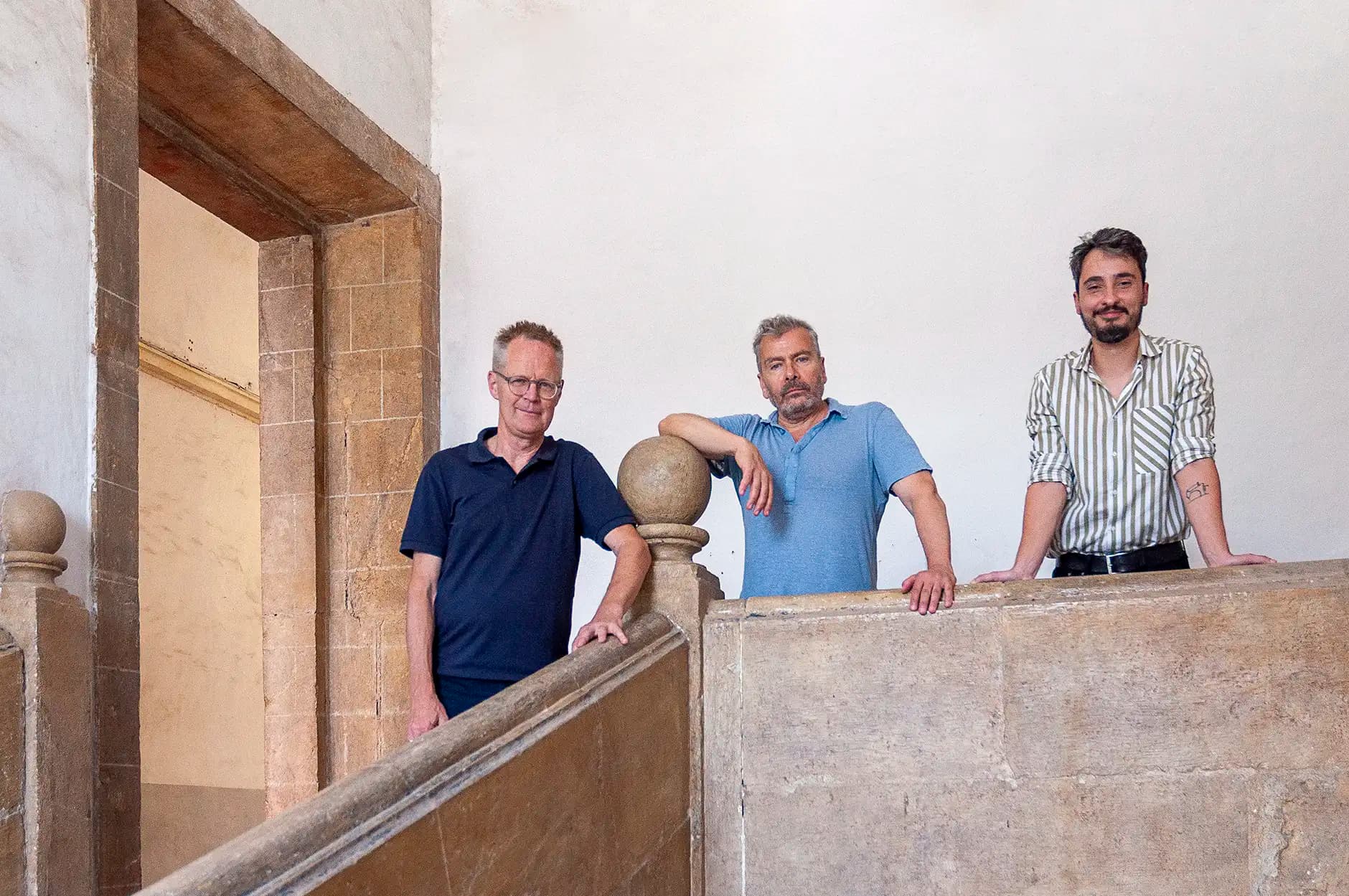
Hans Ibelings teaches at the Daniels Faculty of Architecture, Landscape and Design of the University of Toronto, and is the editor and publisher of the Architecture Observer and Maas Lawrence (together with Nanne de Ru).
Prior to moving to Canada in 2012, he was the editor and publisher of the Amsterdam-based magazine A10 new European architecture, which he founded in 2004, together with graphic designer Arjan Groot.
Hans studied art history at the University of Amsterdam; in 2019, he obtained his PhD at the University of Coimbra. Hans has curated architectural exhibitions since 1989.
He is the author of a number of books, including Modern Architecture: A Planetary Warming History (2023), European Architecture since 1890 (2011), Supermodernism: Architecture in the Age of Globalization (1998) and several monographs on contemporary architects. The working title of his current book project is ‘ABC: Anything but Canonized’, a history without hierarchy of structures, built and destroyed environments, and landscapes shaped by human intervention and neglect.
John Zeppetelli (Montreal, Canada) was the Carol and Morton Rapp Curator, Contemporary Art, at the Art Gallery of Ontario in Toronto, Canada.
Before joining the AGO in 2024, he was Director of the Musée d’art contemporain de Montréal for over a decade, where he led a large team and curated numerous widely acclaimed exhibitions.
He previously held curatorial positions at Phi Foundation for Contemporary Art in Montreal and at the ICA in London (UK). Among his most recognized curatorial projects are Re-enactments (2008), Chronicles of a Disappearance (2012), Ragnar Kjartansson (2016), Mundos, Teresa Margolles (2017), Leonard Cohen: A Crack in Everything (2017), Terror Contagion, Forensic Architecture with Laura Poitras (2021), and Phase Shifting Index, Jeremy Shaw (2023).
Zeppetelli has curated media arts festivals in Canada and Europe, and taught Video Art at NSCAD University and Concordia University. An award-winning filmmaker, he has had his works exhibited internationally at festivals and galleries.
Daniel Madeira (Coimbra, 1992) holds a BA in Artistic Studies from the Faculty of Arts and Humanities of the University of Coimbra and an MA in Curatorial Studies from the Colégio das Artes, University of Coimbra. He is Assistant Director at the Círculo de Artes Plásticas de Coimbra (CAPC) and Assistant Curator of Anozero’26. He develops curatorial projects, including Jogo do Sério, at the CAPC MUSEUM (2023–), Do lado mais visível das imagens, at the Coimbra Contemporary Art Center (2024), and 21 minutes pour une image and fight Lookism!! ou O meu olhar é pouco para ver-te, for CAPC in 2026. He is a contributor to Umbigo Magazine.